
Your Home’s Electrical Anatomy: A Field Guide for Dover & Seacoast Homeowners
The term “panel upgrade” is common, but it’s only one piece of a much larger system. Your home’s electrical service is the entire assembly of hardware that brings power from the utility grid to your outlets. For homeowners in Dover, Somersworth, and the surrounding Strafford County towns, the age of local homes, from 1800s colonials to 1970s ranches, means these systems vary dramatically. This guide breaks down each component from the perspective of our licensed NH electricians.
Beyond the Breaker Box: Understanding Your Full Electrical Service
An electrical service is everything from the street-side connection to the grounding rod buried in your yard. It’s the infrastructure responsible for safely handling your home’s electrical load. In older Seacoast homes, particularly those built before 1970, we often find original 60-amp or 100-amp services struggling to support modern life. This strain isn’t just inconvenient; it’s a direct cause of common problems like flickering lights and overloaded circuits that our technicians diagnose regularly.
The Path of Power: Key Electrical Service Components We Service
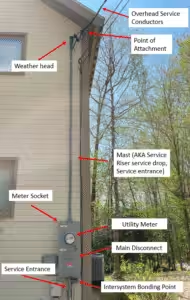 Here are the primary components our electricians evaluate, and the issues we commonly find in local homes.
The Utility Connection Point (Eversource Drop)
This is where your home’s electrical system begins. Power arrives via an overhead service drop or an underground service lateral from Eversource. While Eversource is responsible for the lines leading to your house, the property owner is responsible for the attachment point and all the equipment that follows. After a strong Nor’easter, we get calls about damaged service drops. Eversource handles the wire itself, but any damage to your home’s mast or mounting hardware requires a licensed electrician for repair before power can be safely restored.
Service Mast and Riser Assembly
The service mast is the rigid metal conduit that brings the overhead wires down the side of your house to the meter. In coastal towns like Rye and Hampton, salt air accelerates corrosion on galvanized steel masts noticeably faster than inland. In older Dover homes, we also find masts that were improperly flashed, letting water track behind the siding and into the building envelope, a problem that can go unnoticed for years.
The Meter Socket: Your Responsibility, Not the Utility’s
Eversource owns the meter that measures your usage, but the metal box it sits in, the meter socket, is homeowner property. A common failure point in homes from the 1960s and 70s is a socket with corroded contacts or cracked insulators. A buzzing sound from your meter area is a warning sign that the socket may be failing and needs inspection promptly.
Main Disconnect Switch
The National Electrical Code (Article 230) requires a means to shut off all power from a single point. In most modern installations, this is the main breaker in your panel. In older properties, especially multi-family homes in downtown Dover or Portsmouth, it might be a separate fused switch. We have replaced older switches after finding the internal contacts fused together from a past surge, leaving the home with no functional main disconnect and the owner none the wiser.
The Main Electrical Panel (The “Breaker Box”)
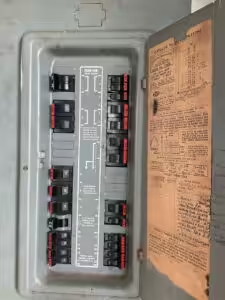
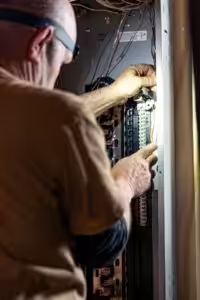 This is the distribution hub for your home. We still find homes in Strafford County with outdated panels from Federal Pacific Electric (FPE) or Zinsco, which are known for breaker failures and have been flagged by inspectors for decades. An upgrade isn’t just about adding circuits. It involves replacing the panel’s core busbar, installing modern arc-fault (AFCI) breakers where code requires them, and making sure the panel can handle the load from an EV charger or a new heat pump system.
The Grounding Electrode System
This system is your home’s most important safety feature, designed to safely divert fault current into the earth, and it is not simply a single rod. A complete system includes a grounding electrode conductor connecting the panel to buried ground rods and bonding to the metallic water service pipe where one exists. In many pre-1950s homes with knob and tube wiring, this system is incomplete or entirely absent, a major safety risk that means modern three-prong outlets provide no actual protection even though they look the part.
Why a Seacoast Home’s Age and Location Dictate Service Needs
A 100-amp service that was adequate for a home in 1985 is often a liability today. The electrical demands of modern kitchens, home offices, and the growing number of electric vehicles in our area have made many older services functionally obsolete. Flickering lights when the central air kicks on, or a breaker that trips every time you run the microwave, are not minor quirks. They are symptoms of an overloaded system. Upgrading isn’t just about capacity; it’s a safety measure that protects your property and lets it function as a modern home.
Your Strafford County Electrical Service Partner
From our base in Somersworth, we serve the entire Seacoast region, and our reputation is built on thorough, code-compliant work. If you suspect your home’s electrical service is struggling to keep up, contact Loyal Lab Electric & Generators for a detailed assessment with upfront pricing and a clear explanation of exactly what your system needs. Every job is backed by NH Master Electrician license #13956.
Call us at 603-605-1912 or schedule through our contact page. We serve Dover, Somersworth, Rochester, Durham, Portsmouth, and surrounding NH and Maine communities.